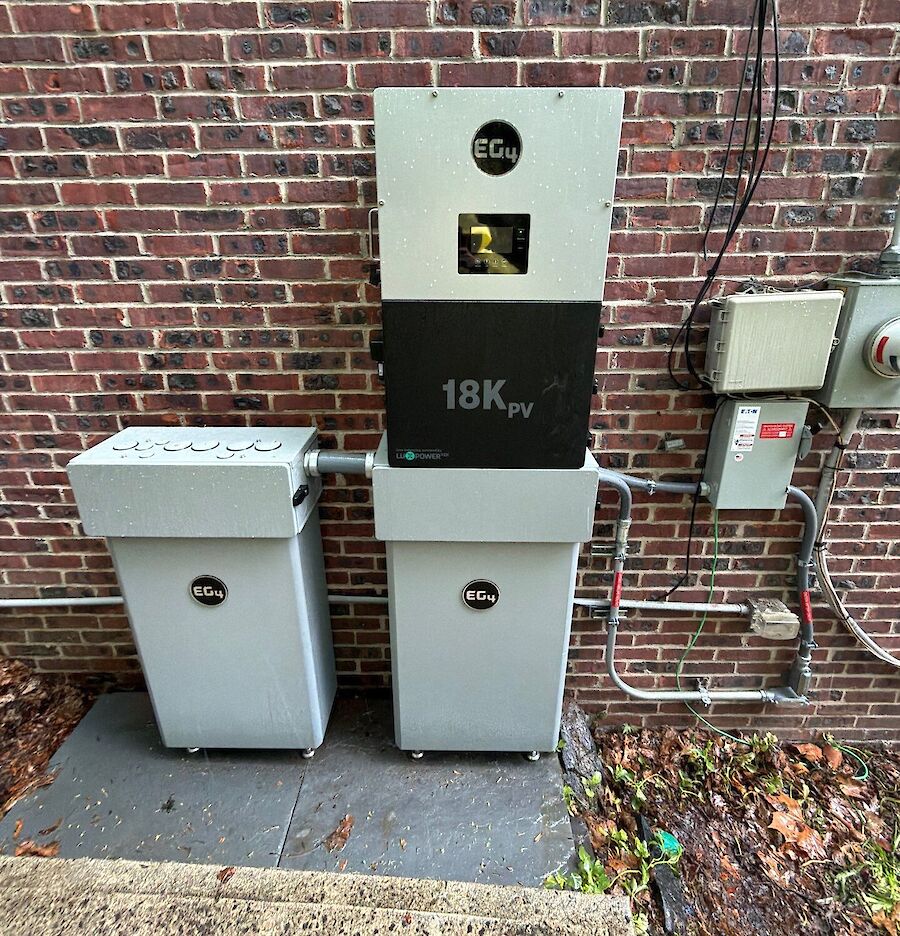
Why We Switched from Battery SOC to Voltage Control on an EG4 16 kWh Battery System
When integrating lithium batteries like the EG4 16kWh WallMount Battery with hybrid inverters, communication issues can sometimes cause unreliable State of Charge (SOC) readings. In this case, the battery communication cable failed, so the system was configured using voltage-based charging and discharging parameters instead of SOC-based controls.
Here’s why that approach can actually work better in certain situations.
The battery communication cable (Ethernet/CAN communication line) between the inverter and battery was not functioning correctly.
Without proper communication:
The inverter cannot reliably read:
Battery SOC
Internal battery calculations
Cell balancing status
Battery management system (BMS) data
Instead, the inverter only sees:
Battery voltage
Positive and negative DC terminals
This means the inverter must operate using voltage thresholds instead of smart lithium communication.
SOC (State of Charge) is not simply a voltage reading.
The battery estimates SOC using:
Voltage
Current flow
Charge/discharge history
Temperature
Internal algorithms
Cell balancing calculations
Because lithium batteries maintain a relatively flat voltage curve for much of their usable capacity, SOC percentages can fluctuate unexpectedly.
Examples:
SOC may suddenly jump from 40% to 25%
SOC can stall at one percentage
SOC readings may drift over time
Batteries may prematurely stop discharging if SOC estimates are inaccurate
This is especially common when communications are unstable or missing.
Instead of relying on fluctuating SOC values, the inverter was configured using lead-acid style voltage parameters.
In this setup:
Charging and discharge decisions are based only on voltage
The inverter ignores SOC percentages
The system operates directly from battery terminal voltage
For this application, voltage was considered more stable and predictable than inaccurate SOC calculations.
EG4 Voltage Reference Example
For this battery setup:
56.2V ≈ 100%
46V ≈ empty/cutoff
Approximate rule used:
About 1 volt ≈ 10% battery capacity
Example rough estimates:
| Voltage | Approximate Capacity |
|---|---|
| 56V | 100% |
| 55V | 90% |
| 54V | 80% |
| 53V | 70% |
| 52V | 60% |
| 51V | 50% |
| 50V | 40% |
| 49V | 30% |
| 48V | 20% |
| 47V | 10% |
| 46V | Empty/Cutoff |
These are approximate operating references, not exact lithium SOC calculations.
With SOC-based cutoff:
A battery reporting 20% SOC may stop discharging early
Remaining usable energy may still exist
Poor SOC calculations can reduce usable battery capacity
With voltage-based control:
The inverter continues discharging until true voltage limits are reached
More usable energy can often be extracted safely
Operation becomes simpler and more predictable
If battery communications fail:
Verify correct CAN/RS485 pinout
Confirm proper Ethernet cable type
Ensure no damaged RJ45 connectors
Verify communication DIP switch settings
Confirm inverter protocol compatibility
Use a multimeter at the battery terminals to confirm:
Actual battery voltage
Voltage sag under load
Charging voltage behavior
If communications are unavailable:
Set inverter to:
Lead Acid
User Defined
Voltage Control Mode
Then manually configure:
Bulk voltage
Float voltage
Low voltage cutoff
Reconnect voltage
Lithium batteries can sag temporarily under large loads.
Examples:
HVAC startup
EV charging
Large motor loads
A temporary voltage dip can trigger premature shutdowns if cutoff voltage is set too aggressively.
In this system, voltage-based battery management proved more reliable than unstable SOC readings caused by failed battery communications.
Rather than relying on fluctuating software estimates, the inverter simply monitored real battery voltage directly from the battery terminals.
For many off-grid and hybrid systems, especially during communication failures, voltage-based control can provide:
More stable operation
Better usable battery capacity
Fewer false shutdowns
Simpler troubleshooting
Proper voltage settings remain critical to avoid over-discharge and protect long-term battery health.